Checked 27 October 2026
Where are Japanese snowboards actually made?
See also
A Japanese brand does not always mean a board made in Japan. Here is what each one says about where its boards are actually built, with the sources.
Introduction
Ask where a snowboard was built and you will usually get an answer about where the brand is from. Those are not the same thing.
Where a board is actually manufactured is harder to find than you would expect. Sometimes it is in a FAQ. Sometimes it appears only on the Japanese version of a website. Sometimes it is in the legal small print of a web shop. Sometimes a brand gives different answers for different models.
So we went and looked, brand by brand, at what each company says about its own manufacturing. We have put ourselves in the list too. Wherever possible the information below comes directly from the brand, and the sources are at the bottom.
This is a short list, not the whole industry. There are many more Japanese brands than the ones here, and we will keep adding to it.
Manufacturing arrangements change, and at least one brand on this list has changed its own within living memory, so if you are reading this long after the date at the top of the page, check again.
01 / The short answer
The short answer
Ordered by how much each brand publishes, from the most specific to the least. We are last.
| Brand | What the brand says about manufacturing |
|---|---|
| Gentemstick | Country of origin published per model. Of the 66 boards in the 26-27 collection, 47 are made in China and 19 in Japan. |
| TJ Brand | Factory named per model. Made at YAQUI, now GP87, in China. The Shapers line is made in Japan. |
| Gray Snowboards | Made at factories in Japan and Taiwan, labelled on each model. Factories not named. |
| Moss Snowstick | Made at factories in Japan and China. Locations not named. |
| Ogasaka | Made at their own head office factory in Nagano City, Nagano. |
| November | Made by Ogasaka Ski Mfg at 653 Kurita, Nagano City. |
| VOLTAGE MFG | Made at their own factory in Minamiuonuma, Niigata. Completely in house. |
| SECCA | One of Act Gear’s own brands. Act Gear’s craftsmen are described as working in Tsubame-Sanjō, Niigata. |
| Island Snowboards | Made at their own workshop in Kutchan, Hokkaido. Address published. |
| Koya Snowcraft | Made at their own workshop in Hakuba, Nagano. |
| SIN.SNOWBOARD | Handcrafted end to end including the press. Trader address in Minamiuonuma, Niigata. |
| Kijima | Handmade in Nagano. No town given. |
| GREEN.LAB | Made in Japan, at a Japanese factory. Factory not named. |
| Vector Glide | Made in Japan, at a domestic factory. Factory not named. |
| MOSIRITA | Handmade to order on Hokkaido timber, with Japanese-made edges. Workshop not named. |
| Rice28 | Not stated. A domestic brand since 1995, no pressing location given. |
| Field Earth | Not stated. Full specs published, no country of origin. |
| Outflow | Not stated. Made to order in limited numbers, from a studio they place in Nagano. |
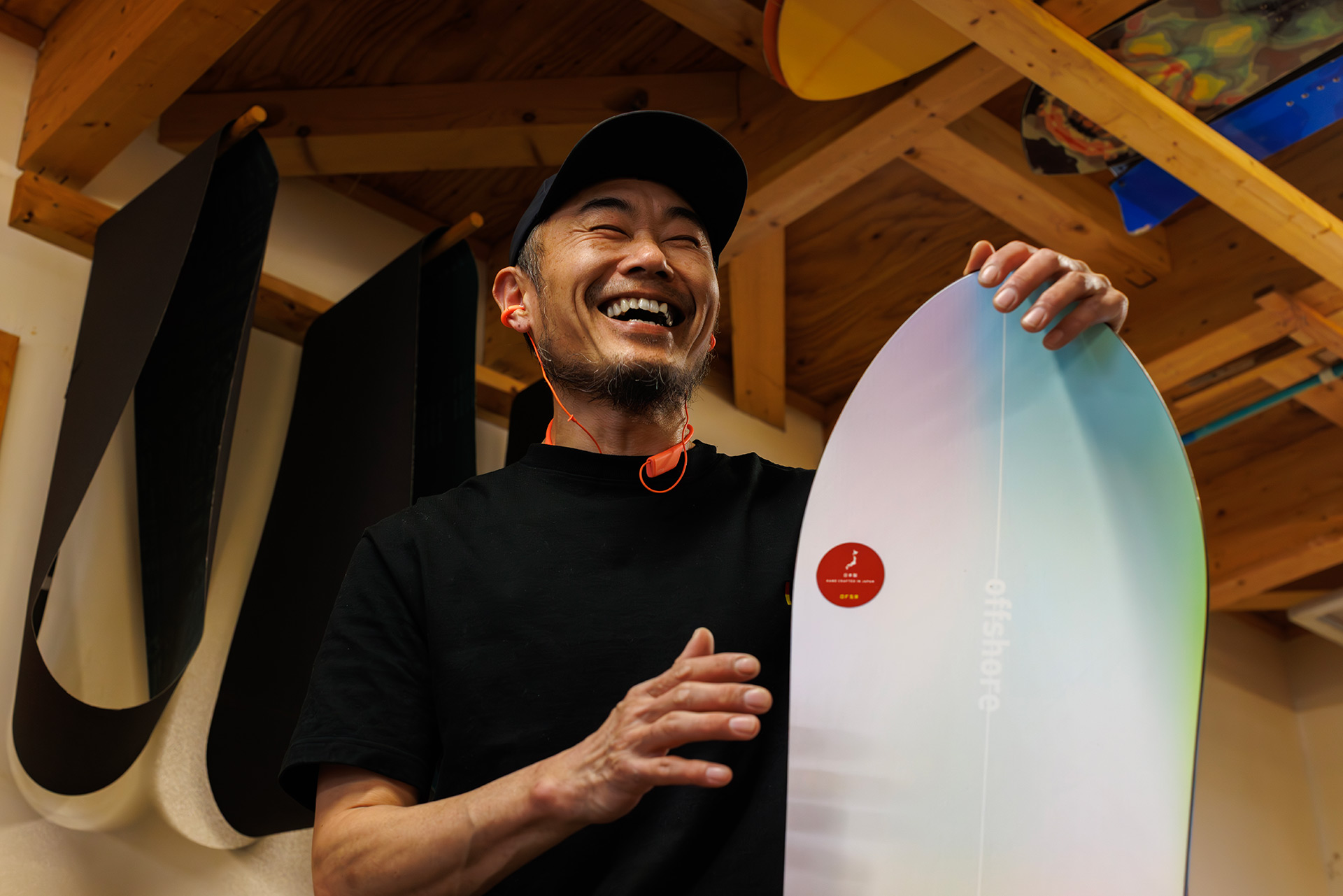
| Offshore Snow Shapes | Made at our own factory in Niseko, at the base of Moiwa resort. |
Designed in Japan, Japanese owned, and made in Japan can all mean different things.
Gentemstick
Gentemstick answer the question on every product page, and they answer it in two lines stacked one above the other:
Designed by GENTEMSTICK in Niseko
Manufactured in China
That is the whole of this article printed by one brand, on one page, in the right order. Designed in one place, built in another, and said plainly. Not every board reads China. A select few read Japan. But the shape of the thing, two different places on two consecutive lines, is exactly what a shopper skims past.
Roughly seven in ten of the 26-27 range is made in China. We opened all sixty-six boards in their current snowboard collection and read the origin line on each: forty-seven China, nineteen Japan. Every product page carries 原産国 in Japanese and the English equivalent, and the two always agreed.
That collection is Gentemstick’s own, and it is worth knowing what is in it: alongside the solid boards there are seven Chopsticks splitboards, three kids’ boards, two bindingless Powderstick powder-surf craft and a pool deck. We have counted their collection as they publish it rather than deciding on their behalf what is and is not a snowboard.
The split runs by model, not by family, which matters if you are shopping. Within the Mantaray range, the 142, 145, 149, 156 and Giant 159 are made in China, while both Baby Mantaray 148s and the 154 are made in Japan. Any sentence of the form “Mantarays are made in X” is wrong whichever country you choose.
Asked directly what country the snowboards are made in, their FAQ says the brand uses two high quality factories inside Japan, plus a factory in China run by an American operator.
That answer is published only in Japanese. It sits at question 32 of 35, and the FAQ is in Japanese even at the English URL, so an English-speaking reader has to run the page through a translator to find it. The information is there. It is just not in their language.
Where in Japan, they do not say. The FAQ gives the countries and the number of factories and stops. No prefecture, no city, no factory name.
That gap is worth naming, because a lot of people believe Gentemstick boards are made in Niseko. The building most people mean is their showroom, which their own page describes as a showroom on the first floor and a shop on the second, at an address in Kutchan. A board sold in Kutchan is not a board built in Kutchan, and the brand has never said otherwise. It is an assumption readers have made, not a claim Gentemstick have made.
TJ Brand
TJ Brand print the factory on the product page, model by model.
Across the 3 Dimensions, Terrain Series and Catamaran lines, every one of the fourteen models carries the same line: factory/ YAQUI. Yaqui Sports was the earlier company of GP87’s founder, and GP87 says on its own site that it manufactures in Shenzhen, China.
The Shapers boards are a different answer, and the Japanese page is where you find it. Those models sit under a project called THE PLANT, described there as 純日本生産, purely Japanese production, with the wood cores and most of the materials sourced in Japan.
The prices follow the split. A Catamaran is ¥151,800 and a Cruiser ¥126,500. A Shapers board starts at ¥203,500 and the top of the line runs far beyond it.
Their own thirty-year anniversary passage describes a journey that began in 1996, when they walked into a small snowboard factory in Bellingham and asked for boards built to Japanese specification, and then moved through Vancouver, Austria, Taiwan, China and Japan, until some of the work is now done by their own hands. So there is no single answer for TJ Brand, and they have never pretended there is. Check which line the board belongs to.
Gray Snowboards
Gray label the origin on each model, as TJ Brand do.
Their line carries a made-in label per board, split between Japan and Taiwan, and their technology page describes production at high quality factories inside Japan alongside a development collaboration with a Taiwanese factory that has matured in recent years. The factories are not named.
Moss Snowstick
Moss state it plainly too, and in English.
Their FAQ says boards are manufactured at top-tier factories in both Japan and China, with trusted partners they have worked with for decades, and that all design, engineering, on-snow testing and final quality control are conducted in Japan.
Like Gentemstick, Moss do not say where in Japan. The places that appear in their own story are the brand’s origins rather than an address: Shonan Kamakura, where Shinzo Tanuma was shaping surfboards and opened the town’s first surf store, and Akakura Onsen in Niigata, where in 1971 he rode his first snow prototype, a 130 by 25 centimetre board in urethane foam and fibreglass. The first boards went on sale under the Moss Snowstick name in 1979, eight years later. Their own banner dates the brand from the prototype: snowsurfing since 1971.
Ogasaka
Worth naming because it shows that made in Japan says nothing about scale.
Ogasaka’s own brand page carries three words across the top: carving, made in Japan, Nagano. The snowboard brand was born in 1987 out of 小賀坂スキー製作所, which they describe as Japan’s oldest ski maker, now in its hundred and thirteenth year. Its head office factory is in central Nagano City, and the boards are described as built one at a time by the hands of Japanese craftsmen.
It is not a small workshop. It is a long established Japanese manufacturer operating at a very different scale from everyone else on this list.
November
November do not hide behind the brand name. Their own company page separates manufacture from sales and names both companies.
Manufacture: 株式会社小賀坂スキー製作所, at 653 Kurita, Nagano City. Sales: 小賀坂スキー販売株式会社, at the same address. The brand started in 2002 as an in-house brand of what the page calls OGASAKA FACTORY. So a November is an Ogasaka-built board under a different name, which makes them the only entry here whose manufacturer is another brand on this same list.
VOLTAGE MFG
They have their own factory at the foot of Hakkaisan in Minamiuonuma, Niigata, with the machine tools required, and describe production as 完全自社生産, completely in house. Boards are made one at a time to each rider’s request, and even the standard models can have their shape adjusted in 0.1 mm increments.
On materials they are unusually careful, and it is worth quoting the order rather than summarising it. They source, as far as possible, within Minamiuonuma City, then within Niigata, then within Japan, then overseas. That last step is stated rather than hidden, which is the opposite of how most brands handle the same fact.
SECCA
SECCA are one of Act Gear’s own brands, and say so on their own site, naming the company and linking to it.
Act Gear’s own blog describes SECCA and UNIT mfg. as Act Gear in-house brands, built with the skill and long experience of craftsmen in Tsubame-Sanjō, Niigata, making high quality domestically produced snowboards. Read that sentence closely and the location attaches to the craftsmen rather than to SECCA directly, which is the honest way to report it.
SECCA’s own pages make their domestic claim about timber rather than about the board: they use good quality domestic wood. The made-in-Japan statement comes from Act Gear’s side of the relationship, not SECCA’s.
Act Gear is a name worth knowing, because it turns up more than once. GREEN.LAB name an Act Gear sole on every board they make.
Island Snowboards
Island make every board in Kutchan from start to finish. In their words, from laminating their cores, graphics production, pressing and finishing.
The workshop address is published on their site, 268-02 Takasago, Kutchan, and they describe the factory as open to anyone curious about how the boards are made. It is open from 2pm to 6pm.
Koya Snowcraft
Koya build in Japan, at their own workshop in Hakuba, four hundred metres from the bottom of Hakuba Goryu, making their own wood cores by hand from hinoki.
They are the quietest maker on this list. No press page, no retailer listing, two blog posts, and a shop page that is still coming soon. What they publish, they publish themselves, on their own site and on Instagram. That is how they choose to operate.
SIN.SNOWBOARD
SIN is a good example of how buried this information can be, because the answer is not in the brand copy at all.
Their own page says every board is handcrafted, and that everything from the graphics through the design to the pressing is carried out as a single continuous process. That is a claim about method, not about place. The only geography in the brand copy belongs to the timber: the 越後杉, Echigo cedar, grown in Niigata’s hard winters and strong enough to give the board its spring. Read quickly, that looks like a made-in claim. It is not. It is a statement about a tree.
The location is in the legal small print of their web shop. Their trader disclosure gives the seller as 木村顕悟 at an address in Minamiuonuma, Niigata. That is the brand’s own declaration, and it is the only place on any page of theirs that names a town.
Which makes Minamiuonuma the second entry on this list from one small Niigata city, alongside VOLTAGE MFG at the foot of Hakkaisan.
The boards come in nine outlines with fifty graphics to choose from, all drawn by Kengo Kimura.
Kijima
Kijima, 木島板工房, have been building bamboo-cored snowboards since 2014 and describe them as handmade in Nagano, Japan.
They are a workshop rather than a catalogue. Boutique timber top sheets, custom length, width and flex, and an order placed by message rather than through a shopping cart. Everything they publish, they publish themselves.
GREEN.LAB
GREEN.LAB have been going since 2004, based at Minenohara in Suzaka, Nagano.
In their own words: they use Japanese wood and have the boards made at a reliable Japanese factory, testing the ride as they go. Every board in their catalogue is marked made in Japan. The factory is not named. Every model carries an Act Gear sole.
Vector Glide
Vector Glide say every model is made in Japan.
Their philosophy page puts it plainly: every model is produced at a domestic factory, and having the factory in Japan is what lets them convey an image and a set of numbers accurately. They describe wood naturally dried and matured for around three years, and an output of only about five a day.
They say a domestic factory rather than their own factory, and they do not name it on any page we read. Elsewhere on the site, in a tuning context, they do refer to “the VectorGlide manufacturing factory”, so the distinction may be softer than the philosophy page implies. It is worth noticing and not worth reading too much into.
MOSIRITA
MOSIRITA take their name from the Ainu words モシリ, island, and イタ, board, and describe themselves as a handcraft snowboard maker born in Hokkaido.
They say a good deal about how a board is made. Every one is handmade, one at a time, after the order is placed, built to suit the individual rider. The timber is Hokkaido, selected in the forest alongside the people who mill and dry it. The edges are 国内生産, domestically produced, kept full length wherever possible and shaped entirely by hand. Four shapes are offered, APELETA, IMELU, LAMANTE and LEILA, plus a full custom order.
Where any of that happens, they never say. Their own description places the brand’s birth in Sapporo, and their contact number is a Sapporo one, but a birthplace and a phone number are not a workshop. There is no address on any page of theirs.
Of everyone on this list who does not name a place, they are the one who sounds most like they are standing at the bench.
Rice28
Rice28 describe themselves as a forerunner of domestic brands, started in 1995, from a time when Japanese-made freestyle boards did not yet exist.
They never state where today’s boards are pressed. Their only address is a contact address in Suzaka, Nagano, which they do not describe as a production site. The 1995 line implies Japanese manufacture historically and says nothing about now.
Field Earth
Field Earth publish full specifications per model, down to tenths of a millimetre on the waist, and no country of origin anywhere on the page. The C165 gives length 1650 mm, nose 307 mm, waist 258.9 mm, tail 297 mm, camber, effective edge, contact length, sidecut, stance range and a price of ¥96,800, with nothing about where it is built.
The brand is from Hokkaido. Their logo is the Daisetsu-Tokachi range, the founder began his litter-picking climbs on Asahidake, and the name first appeared on their site in 2003. Their history runs year by year from 2000 to 2025 and never once names a factory or a country.
Outflow
Outflow’s own store says boards are made to order in limited numbers, with a reservation asked for anyone who wants a new model, and describes itself as Soultime studio in Nagano. The legal disclosure on the store gives a platform address in Tokyo rather than a workshop, so Nagano rests on how they describe themselves. Where the boards are built is not stated on any page we could open. The same store also carries the name Life Riddim.
Most of the brands on this page do not publish where their boards are built, and none of that is an accusation. It is simply the state of the industry, and it is the reason this article exists.
Offshore Snow Shapes
That is us. Here is ours.
Every Offshore snowboard is made in our factory in Niseko, at the base of Moiwa resort.
Not just designed here. Made here.
The core is cut and profiled here. The steel edges are bent around the shape by hand. The board is laid up, pressed, cured, finished, tuned and waxed in the same building. There is no second production factory.
What goes into one, in our own words: a fullwood core of vertically laminated paulownia with four mountain ash stringers, an Austrian carbon sintered 7515 base, full wrap German steel edges, Australian fibreglass, and sidewalls we pour rather than glue, liquid polyurethane run into a channel cut along the core so it cures into one seamless piece. Japanese resin. Pre-tensioned carbon tow through the sections that take the load, carbon-wrapped flax rods, and Innegra around the inserts.
The board is made in Niseko. The parts come from wherever the best version of that part is made, because that is what the board deserves. What happens here is the making: Japanese craftsmanship, at the base of one of the best powder mountains in the world.
One press. A small team of master craftsmen. No step where quality, materials or design gives way.
Every board is made to order, and we build a limited number each year.
02 / One more, which is a yukiita brand
One more, which is a yukiita brand
Buddha Blank
Buddha Blank make 雪板, yukiita: lightweight solid wooden boards ridden without bindings. Not snowboards, and they do not claim to be. Their boards are the KARUSUGI long, semi-long and short, and they describe them as developed by people who love snowboarding, skateboarding and surfing.
They are a Japanese brand from Yamagata Prefecture. Their workshop, Outback Labo, is in Kawanishi, and they describe it as a woodworking atelier where craftspeople, musicians and artists build the boards and run workshops for anyone who wants to shape their own.
They are here because it is the same question asked of a different object, and because the answer is the simplest on the page. They are made where the workshop is.
03 / Made elsewhere does not mean made badly
Made elsewhere does not mean made badly
Some exceptional snowboards are manufactured in large specialist factories outside Japan. Country of manufacture is not a measure of quality by itself.
Large factories can produce extraordinary consistency, at a scale and a price no small builder can match. What a small builder can offer is different, and it is not mainly about geography.
The people making the boards ride them. Every step matters twice over: how it is built, and what it will do on snow. We notice the details because we are the ones who will feel them.
Nothing forces a compromise. We are not working back from a price, so materials, quality and craftsmanship are not the things that give way. The boards are not cheap, and that is the reason.
Proximity is real, and fewer small builders have it than you would think. Design, testing and production happen in the same place, so the loop is short. Build it. Ride it. Change it. Ride it again. A shape can be ridden in Niseko, changed, rebuilt and ridden again without the conversation ever leaving the factory.
That is the distinction we care about. Not a flag on the box.
04 / How to check for yourself
How to check for yourself
Five things work, in roughly this order.
Read the product page first. Some brands print the country of origin, or even the factory, on the page where you buy the board. Gentemstick give the country per model, in both languages. TJ Brand and Gray name a factory or a label per model. It takes ten seconds and it beats every other method here.
Read the FAQ, and read the Japanese one. Use your browser’s translation. The Japanese page often says more than the English page. TJ Brand’s Japanese page is where their domestically built line is described as such, and Gentemstick’s manufacturing answer exists only in Japanese even at the English address.
Read the legal page on the web shop. Japanese online stores carry a 特定商取引法 disclosure, usually linked in the footer as 特定商取引法に基づく表記 or “Act on Specified Commercial Transactions”. It gives the seller’s name and address. That is how we found the only town SIN.SNOWBOARD publish anywhere. Be aware it sometimes gives the shop platform’s address instead of the brand’s, which is what happens with Outflow.
Check the retailer listing for 生産国 or 原産国. Japanese shops often state the country of origin even when the brand does not.
Ask. If country of manufacture matters to you, ask the brand directly which country or factory produces the model you are considering. Several of the makers on this list publish nothing at all, and for those it is the only method that works.
05 / So what is actually made in Japan?
So what is actually made in Japan?
If you are specifically looking for a snowboard physically made in Hokkaido, Offshore in Niseko and Island in Kutchan are two clearly verified examples.
In Nagano there are three, at very different scales. Koya build by hand in a workshop in Hakuba. Kijima build by hand in the prefecture without saying where. Ogasaka manufacture at their own head office factory in Nagano City, and the company behind them has been going for over a hundred years.
In Niigata there are three. VOLTAGE MFG at the foot of Hakkaisan in Minamiuonuma. SIN.SNOWBOARD, whose trader address is in the same city. And Act Gear in Tsubame-Sanjō, who build for more than one brand on this list.
Gentemstick say their production is split between two Japanese factories and one Chinese factory, and publish which country each model comes from. Moss say they manufacture in both Japan and China. TJ Brand split by line, naming a Chinese factory on three of them and describing the Shapers line as purely Japanese production.
That is the useful distinction, and it is four steps, not one:
Japanese brand.
Designed in Japan.
Made in Japan.
Made in Hokkaido.
They are not interchangeable descriptions, and a brand can honestly claim the first without the last.
06 / Common questions
Common questions
Are Gentemstick snowboards made in Japan?
Some are, and Gentemstick tell you which. Every product page carries the country of origin for that model, in Japanese and English. Of the sixty-six boards in the 26-27 collection, forty-seven are made in China and nineteen in Japan. The split runs by model rather than by family: within the Mantaray range the 154 is made in Japan while the 149 and the 156 are made in China. They do not say where in Japan the Japanese boards are built.
Are Gentemstick snowboards made in Niseko?
No, and they have never said so. Their FAQ says the boards are made at two factories in Japan plus one in China, and does not say where those factories are. The building people usually mean is their showroom, described on their own page as a showroom and a shop, at an address in Kutchan. Niseko is where the brand is based and where its boards are designed, not where they are stated to be built.
Are Moss Snowstick boards made in Japan?
Some are. Moss say they manufacture at top-tier factories in both Japan and China, with partners of decades’ standing, and that design, engineering, on-snow testing and final quality control all happen in Japan. They do not say which models come from where.
Are TJ Brand snowboards made in Japan?
Some are. TJ Brand name the factory on each product page. The 3 Dimensions, Terrain Series and Catamaran lines are built at YAQUI, the earlier name of GP87, which manufactures in Shenzhen, China. The Shapers line is described on their Japanese site as purely Japanese production. Check which line the board is in.
Which snowboards are made in Hokkaido?
Offshore Snow Shapes in Niseko and Island Snowboards in Kutchan are two verified examples of builders physically manufacturing snowboards in Hokkaido.
Which snowboards are made in Nagano?
Koya Snowcraft build by hand at their workshop in Hakuba and Kijima build by hand in the prefecture without naming a town. Ogasaka manufacture at their own head office factory in Nagano City, at a much larger scale, and November boards are built by Ogasaka at the same address.
Which snowboards are made in Niigata?
VOLTAGE MFG build at their own factory at the foot of Hakkaisan in Minamiuonuma, and SIN.SNOWBOARD give a trader address in the same city. Act Gear’s craftsmen are described as working in Tsubame-Sanjō, and Act Gear build SECCA and UNIT mfg.
Where are Offshore snowboards made?
Offshore Snow Shapes boards are made at the Offshore factory in Niseko, Hokkaido, at the base of Moiwa resort.
Does “Japanese snowboard brand” mean “made in Japan”?
No. A snowboard can be designed, developed and tested by a Japanese company while being manufactured elsewhere. Gentemstick print both facts on the same product page, one line apart: designed in Niseko, manufactured in China. Check the individual model or the manufacturer if country of origin matters to you.
Does made in Japan mean handmade?
No, and the two are worth separating. Ogasaka have manufactured in Nagano for over a century at a scale no workshop could match, and there is still hand work in their boards. The useful distinction is not handmade against machine made. It is a small boutique workshop against a large manufacturer. Made in Japan tells you the country, not the scale.
07 / Made in Niseko
Made in Niseko
If you want to see where an Offshore is made, our factory is in Moiwa, Niseko.
08 / Sources
Sources
All checked 27 October 2026 unless noted.
- Gentemstick 26-27 snowboard collection, counted model by model across all 66 boards: https://gentemstick.com/en/collections/snowboards
- Gentemstick FAQ, question 32, on manufacturing country: https://gentemstick.com/en/pages/faq
- Gentemstick T.T 158, origin Japan: https://gentemstick.com/en/products/26-27-tt-158
- Gentemstick Mantaray 154, origin Japan: https://gentemstick.com/en/products/26-27-mantaray-154
- Gentemstick Mantaray 149, origin China: https://gentemstick.com/en/products/26-27-mantaray-149
- Gentemstick Mantaray 156, origin China: https://gentemstick.com/en/products/26-27-mantaray-156
- Gentemstick XYZ Chopsticks, origin China, showing the designed and manufactured lines together: https://gentemstick.com/en/products/26-27-xyz-cs
- Gentemstick Niseko showroom: https://gentemstick.com/en/pages/gentemstick-niseko-showroom-the-snowsurf-shop
- TJ Brand product index, 2026-2027: https://tj-brand.com/product/
- TJ Brand 3 Dimensions, factory listed per model: https://tj-brand.com/3dimensions/
- TJ Brand Terrain Series: https://tj-brand.com/terrainseries/
- TJ Brand Catamaran: https://tj-brand.com/catamaran/
- TJ Brand THE SHAPERS and THE PLANT: https://tj-brand.com/tshapers/
- GP87, formerly Yaqui, on its own history and manufacturing: https://gp87.net/pageserver/about-us
- Gray Snowboards technology, checked 2 September 2026: https://graysnowboards.co.jp/tech/
- Gray Snowboards product line, origin labelled per model, checked 2 September 2026: https://graysnowboards.co.jp/product/
- Moss Snowstick FAQ: https://mosssnowstick.com/pages/faqs
- Moss Snowstick origin story: https://mosssnowstick.com/pages/story
- Ogasaka brand page: https://www.ogasaka-snowboard.com/brand.html
- Ogasaka brand history: https://www.ogasaka-snowboard.com/brand_history_e.html
- November, manufacture and sales companies named: https://www.novembermfg.com/company/
- VOLTAGE MFG, on their own factory in Minamiuonuma: https://voltage-mfg.com/
- SECCA, on building at Act Gear: https://www.seccasnowboard.com/
- Act Gear: https://www.actgear.jp/company/philosophy/
- Island Snowboards construction: https://www.island-snowboards.com/snowboard-construction
- Koya Snowcraft: https://koyasnowcraft.com/about/
- SIN.SNOWBOARD, on handcraft and Echigo cedar: https://www.kengokimura.com/sin-snowboard
- SIN.SNOWBOARD trader disclosure, seller address in Minamiuonuma, Niigata: https://faninari.thebase.in/law
- Kijima, 木島板工房, bamboo cores since 2014, handmade in Nagano: https://www.instagram.com/kijimasnowboards/
- GREEN.LAB 2026-27 catalogue, made in Japan, started 2004, Act Gear sole: https://greenlab.jp.net/_userdata/26-27_greenlab_catalog-en.pdf
- GREEN.LAB about: https://greenlab.jp.net/japan/cn7/about.html
- Vector Glide philosophy, on producing every model at a domestic factory: https://www.vectorglide-japan.com/blank-1
- Field Earth C165, specifications with no country of origin: https://www.fieldearthdesign.com/c165.html
- Field Earth history: https://www.fieldearthdesign.com/history.html
- Outflow official store: https://soultime.theshop.jp/
- Rice28: https://www.rice28jp.com/
- MOSIRITA: https://mosirita.com/aboutus
- Buddha Blank store, on the KARUSUGI boards: https://buddhablank.stores.jp/about
- Buddha Blank, Outback Labo in Kawanishi, Yamagata: https://buddhablank.com/outback-labo/